Case study: ARDS chest imaging extraction
About the project
Cincinnati Children's Hospital
Researcher · Mentored by Eneida Mendonca, MD, PhD
Identifying ARDS-related chest imaging findings in free-text radiology reports through schema rules, explicit exclusions and an independent judge prompt.
- Python
- JSON schema
- LLM annotation
- LLM judge
My contribution
Through my school's Schiff Family Science Research Institute, I joined a research team studying how LLMs could identify pulmonary findings in MIMIC-IV radiology reports.
My mentor provided an annotation tool that turns notes into BioXML annotations. I designed the schema, wrote database-filtering steps and built the pipeline connecting to that tool. My mentor handled the oxygenation filtering.
I also built the evaluation pipeline using a judge prompt independent of the extraction schema, and carried out the metrics analysis. My mentor supplied the model API and helped adapt both pipelines from a single-label schema to a multi-label schema.
How I refined the rules
I began with the Berlin chest imaging criterion, then refined the definitions through published research, mentor feedback and error analysis. Inclusion rules were followed by explicit exclusions for findings that should not count.
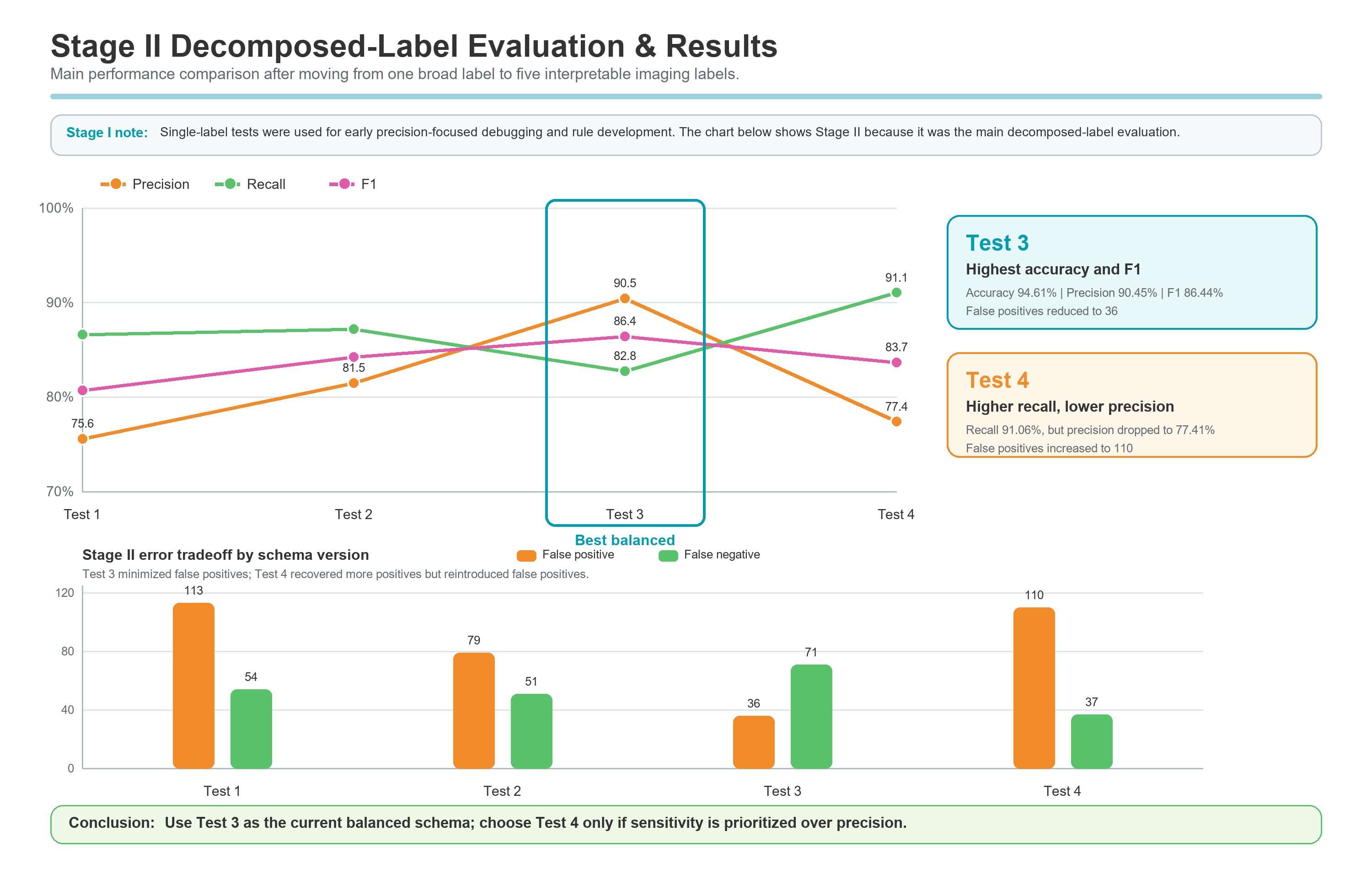
The saved schema versions document a tradeoff: stricter exclusions reduced false positives but also filtered out relevant bibasilar findings. I revised the rules to allow those patterns while continuing to refine the exclusions.
Evaluation
The selected Stage II run evaluated 1,997 reports. Metrics use 1,984 reports with determinate LLM judge labels; 13 uncertain judgments were excluded. This is report-level classification of the chest imaging criterion, with LLM judge labels as the reference.
The saved runs evaluated different numbers of reports, so the comparison figure shows separate run results. Clinician validation remains future work.
I independently presented the findings to Cincinnati Children's Division of Biomedical Informatics at an all-staff meeting.
| Metric | Value |
|---|---|
| Accuracy | 94.61% |
| Precision | 90.45% |
| Recall | 82.77% |
| F1 | 86.44% |
1,997 reports judged · 1,984 used for binary metrics · 13 uncertain labels excluded.
Research presentation
Cincinnati Children's · Division of Biomedical Informatics